Free Shipping on Orders $100+ — Canada


Short answer: Castor oil is a thick plant oil pressed from the seeds of the castor plant and used in hair and beard products for its rich, glossy feel. No oil grows hair, and research on castor oil and hair growth is limited, so treat it as a conditioner, not a treatment.
Key takeaways
- Castor oil is pressed from castor seeds, and about 90% of its fatty acid content is ricinoleic acid.
- No oil grows hair, and a 2022 systematic review found no strong evidence that castor oil does.
- It is very thick: use a few drops, blend it with a lighter oil, and rinse it out well.
- For sudden or patchy hair loss, see a doctor or dermatologist.

Knightsmen Recommends
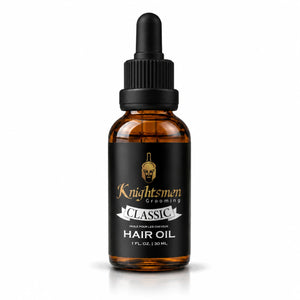
Organic Hair Oil | Classic
An unscented organic hair oil with no essential oils added. Its ingredient list includes organic castor seed oil.
Shop Now →What is castor oil?
Castor oil is a thick plant oil pressed from the seeds of the castor plant (Ricinus communis). About 90% of its fatty acid content is ricinoleic acid. It is noticeably thicker and stickier than most plant oils, so hair and beard products usually blend it with lighter oils.
| Quick reference | Castor oil |
|---|---|
| Source | Seeds of the castor plant (Ricinus communis) |
| Main fatty acid | Ricinoleic acid, about 90% of the fatty acid content |
| Feel | Very thick, sticky and glossy |
| Role in hair products | A rich conditioning ingredient that adds shine |
| Name on a label | Ricinus Communis (Castor) Seed Oil |
| How it is usually used | A few drops, or blended with a lighter oil |
Does castor oil grow hair?
No oil grows hair, and research on castor oil and hair growth is limited. A 2022 systematic review of coconut, castor and argan oils for hair found weaker evidence that castor oil adds shine and no strong evidence supporting it for hair growth. Cleveland Clinic makes the same point: the physician it quotes says there is no data to show that applying pure castor oil to hair promotes growth.
How fast hair grows depends mainly on genetics, overall health and medical conditions. On average hair grows about 4 to 6 inches a year, according to Cleveland Clinic, and the NHS says it is normal to lose between 50 and 100 hairs a day. A thick oil can make hair look glossier, which is a cosmetic effect and not the same as growth.
What does castor oil do for hair and beards?
Castor oil is a rich conditioning ingredient: it coats the hair, adds shine and helps soften dry or coarse hair and beards. Because it is so thick, a little goes a long way, and on fine or straight hair it can weigh the hair down.
Cleveland Clinic's article on hair oiling quotes a dermatologist who says people with dry, coarse or tightly curled hair can benefit from oiling, while fine, straight hair may be weighed down too much. In a beard oil, castor oil is usually one ingredient in a blend rather than the whole oil, so check the full ingredient list to see what else is in it.
How do you use castor oil on hair?
Use a small amount, blended with a lighter oil, and start with the lengths of your hair rather than the scalp. Opinions differ on oiling the scalp: Cleveland Clinic quotes a dermatologist who advises against putting oil directly on it, so ask a dermatologist first if your scalp is flaky or easily irritated.
- Blend it. One simple mix is about 30% castor oil and 70% of a lighter oil such as jojoba. Patch-test the blend first.
- Warm 5 to 8 drops between your palms and work them through dry hair, lengths first.
- If you choose to oil the scalp, part the hair and massage a small amount in with your fingertips for two to three minutes.
- Leave it on for 30 minutes or more, then shampoo it out. A thick oil can take two washes.
- Start with once or twice a week, and up to three or four times if your hair stays comfortable.
If you would rather not mix your own, Organic Hair Oil | Classic is a ready-blended, unscented hair oil whose ingredient list includes organic castor seed oil. You can also browse the organic hair oil collection.
What should you avoid when using castor oil?
Avoid using a lot of it, and avoid putting it on your skin undiluted. These are the main cautions.
- Too much. Castor oil is very thick, and a heavy application can be hard to rinse out.
- Piling it onto long hair. Cleveland Clinic and a published case report describe rare cases of acute hair felting, where hair mats into a hard tangle that may need to be cut off. The case report links it to castor oil's thickness and long hair.
- Using it neat on skin. Cleveland Clinic's physician warns that pure castor oil on skin can cause irritation and allergic reactions, so blend it and patch-test first.
- Counting on it to change hair loss. If hair loss worries you, see a doctor or dermatologist rather than trying oils.
When should you see a doctor about hair loss?
See a doctor or dermatologist if you are worried about hair loss, notice sudden or patchy loss, or see more hair falling out than usual. The NHS advises seeing a GP to find out what is causing hair loss before thinking about a commercial hair clinic. The American Academy of Dermatology says that to get an accurate diagnosis it helps to see a board-certified dermatologist, because the right next step depends on the cause. MedlinePlus lists aging, family history, stress, some medicines and some medical conditions among the causes of hair loss, and an oil cannot address any of them. A hair oil, castor oil included, is no substitute for that visit.
Frequently asked questions
How long does castor oil take to show results for hair growth?
There is no reliable timeline, because no oil grows hair. What a conditioning oil can do is cosmetic, and you can see it as soon as you use it: hair that feels softer and looks glossier. If you are worried about hair loss, see a doctor or dermatologist rather than waiting on an oil.
Is Jamaican black castor oil better than regular castor oil?
No oil grows hair, and there is no strong evidence for castor oil of any kind, so there is no evidence that one type is better. Jamaican black castor oil is a darker oil sold under a traditional name, and brands make it in different ways, so colour, scent and thickness vary. Choose by texture, scent and the ingredient list, and patch-test first.
Can castor oil make hair fall out or damage it?
A thick oil can leave hair heavy and hard to rinse if you use too much, and there are rare reports of hair matting into a hard tangle after castor oil, particularly on long hair. Start with a small amount and rinse thoroughly. If you notice more hair falling out than usual, see a doctor or dermatologist to find the cause.
Can I use castor oil on my beard?
Yes, in small amounts and usually blended. On its own castor oil is very thick and can leave a beard sticky. Mix a few drops with a lighter oil, or choose a ready-made beard oil, then warm it in your palms and work it through the hair and the skin underneath. Patch-test first, and see a doctor or dermatologist if the skin under your beard stays itchy or flaky.
Related guides
Sources
- Cleveland Clinic: castor oil and your health
- Cleveland Clinic: hair oiling, should you try it?
- Cleveland Clinic: how fast hair grows and what affects it
- NHS: hair loss
- MedlinePlus: hair loss
- American Academy of Dermatology: hair loss, getting a diagnosis
- Burdock GA et al. Food and Chemical Toxicology, 2006 (composition of castor oil). PubMed 16831502, doi:10.1016/j.fct.2006.05.007
- Phong C et al. Journal of Drugs in Dermatology, 2022 (systematic review of coconut, castor and argan oil for hair). PubMed 35816075, doi:10.36849/JDD.6972
- Maduri VR et al. International Journal of Trichology, 2017 (case report of hair felting after castor oil). PubMed 28932063, doi:10.4103/ijt.ijt_22_17
Knightsmen Grooming products are cosmetics. This guide is general information, not medical advice. If you have a skin or scalp condition, or sudden changes in your hair, see a doctor or dermatologist.