Free Shipping on Orders $100+ — Canada

Short answer: Jojoba oil is a liquid wax pressed from the seeds of the jojoba shrub, which is native to the Sonoran Desert. Chemically it is made of wax esters rather than the triglycerides found in most plant oils, and beard oils use it as a smooth, light-feeling base. Like any oil, it does not grow hair.
Key takeaways
- Jojoba oil is a liquid wax from the seeds of the jojoba shrub, native to the Sonoran Desert.
- It is made of wax esters, not triglycerides, and it is a common emollient in personal-care products.
- Beard oils use it as a light, smooth base; it conditions the beard and does not grow hair.
- On a label, look for Simmondsia Chinensis Seed Oil, and patch-test any new product first.

Knightsmen Recommends
Organic Beard Oil | Classic
An unscented organic beard oil with no added fragrance. Its ingredient list includes organic jojoba oil.
Shop Now →What is jojoba oil?
Jojoba oil is pressed from the seeds of the jojoba shrub (Simmondsia chinensis), which occurs naturally in the Sonoran Desert in the United States and northwestern Mexico. Unlike most plant oils, which are triglycerides, jojoba oil is a liquid wax: a mixture of esters of long-chain fatty acids and fatty alcohols. That is why it is often called a wax rather than an oil. It is a common emollient in personal-care products.
| Quick reference | Jojoba oil |
|---|---|
| Source | Seeds of the jojoba shrub, native to the Sonoran Desert |
| Type | Liquid wax (wax esters), not a triglyceride oil |
| Feel | Smooth and light-feeling |
| Keeping quality | Good resistance to oxidation |
| Role in a beard oil | A light base that carries the other ingredients |
| Name on a label | Simmondsia Chinensis Seed Oil |
Why do beard oils use jojoba oil as a base?
Beard oils use jojoba oil as a base because it feels light and smooth and keeps well. Many people find it spreads easily and leaves a beard soft without a heavy film when they use a few drops. A laboratory paper describes jojoba's resistance to air oxidation as already good, so it tends to keep well on the shelf.
Even so, store any oil in a cool place with the cap on, and stop using a product that smells off. In a finished beard oil, jojoba is usually blended with other oils, and the blend decides how the product feels, so the base alone does not tell you how an oil will perform on your beard.
What does jojoba oil do in a beard oil?
Jojoba oil is a conditioning ingredient: it helps soften the feel of beard hair, adds shine and helps moisturize the skin underneath. Beard hair is often coarser than the hair on your head, so a dry beard can feel scratchy. A thin film of a smooth, light oil helps the hair feel softer, tames frizz and helps flyaways lie flatter.
The skin under the beard matters too. The American Academy of Dermatology says moisturizing can help soften the skin and beard hairs, and that beard oil suits normal to dry skin and should be used sparingly.
These are cosmetic effects. Jojoba oil is not a treatment, and it does not change how fast a beard grows.
How do you use jojoba oil on a beard?
Use 3 to 5 drops for a short to medium beard and up to 7 for a longer, fuller one, then adjust to how your beard feels.
- Apply after washing, when the beard is clean and slightly damp.
- Warm the drops between your palms so the oil spreads evenly.
- Work it through the hair and massage it into the skin underneath.
- Comb through with a wide-tooth beard comb for even coverage.
If you also use a beard balm, apply the oil first, give it a minute, then add the balm. Organic Beard Balm | Cedarwood is made with beeswax and shea butter for light hold, and our guide to what beard balm does explains the second step.
How do you read a jojoba beard oil label?
Read the ingredient list rather than the front of the bottle. Lists generally run from the largest amount to the smallest, so an ingredient near the top makes up more of the blend than one near the end.
- The name. Jojoba oil appears as Simmondsia Chinensis Seed Oil, sometimes with "jojoba" in brackets.
- The processing. Cold-pressed and refined describe how an oil was made and can change colour and scent. Neither word tells you how a beard oil will feel on you.
- The rest of the blend. The other oils set the feel of the finished product. If you prefer to avoid mineral oil, silicone or synthetic fragrance, the list shows whether they are there.
- The certification. If a label says organic, look for the certifier's name rather than the word alone.
Which Knightsmen beard oils list jojoba oil?
All four of our organic beard oils list organic jojoba oil among their ingredients, and they differ mainly in scent. They are handcrafted in small batches in Toronto, Canada, and the product pages state no mineral oil, no parabens and no synthetic fragrance. Our organic beard balms list jojoba seed oil too. Check the ingredient tab on each product page for the full list.
| Beard oil | Scent |
|---|---|
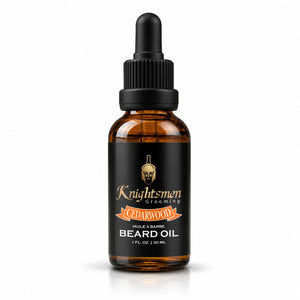
| Organic Beard Oil | Cedarwood | Clean and woodsy |
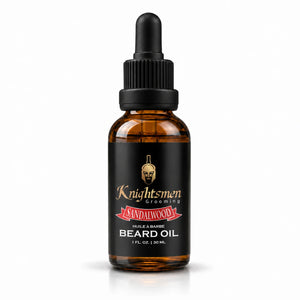
| Organic Beard Oil | Sandalwood | Warm and grounding, not sweet or floral |
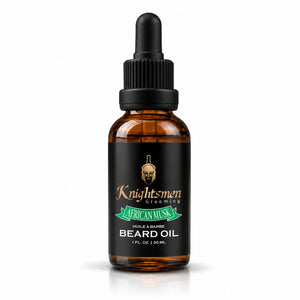
| Organic Beard Oil | African Musk | Grounded and warm, with a woody base and slight sweetness |
| Organic Beard Oil | Classic | Unscented, with no added fragrance |
Should you patch-test jojoba oil?
Yes. Any plant oil can bother some people, jojoba included, so test a new product before you use it every day. The American Academy of Dermatology suggests a quarter-sized spot, such as the bend of your elbow, twice a day for seven to 10 days. If you see no redness, itching or swelling by the end, go ahead and use it.
If a reaction appears, wash the product off and stop using it. If fragrance has bothered your skin before, choose an unscented oil such as the Classic. Keep oils away from your eyes. If the skin under your beard stays itchy, flaky or red, or a reaction is severe, see a doctor or dermatologist.
Frequently asked questions
Does jojoba oil make a beard grow?
No oil grows hair. Beard growth depends mainly on genetics, age and general health. Jojoba oil conditions the hair and helps moisturize the skin, which is a cosmetic effect. If your beard looks patchy or you notice sudden hair loss, a doctor or dermatologist can explain why.
Is jojoba oil really an oil?
Technically it is a liquid wax: a mixture of esters of long-chain fatty acids and fatty alcohols, rather than a triglyceride oil like most plant oils. In a beard oil it behaves like a light, smooth oil, which is why it is sold and used as one.
How often should I use jojoba beard oil?
Many men use a few drops once a day after washing. In dry winter weather you may want a little more, and in humid weather a little less. If your beard feels dry or rough, go back to daily use; if it looks heavy or greasy, use fewer drops or skip a day.
Is pure jojoba oil better than a beard oil blend?
Neither is better for everyone. Pure jojoba is simple, with a single ingredient. A blend combines oils for a different feel and often adds a scent. Choose by how it feels on your beard and whether you want fragrance, and patch-test either one first.
Related guides
- Argan oil for beard: what it is and how to use it
- How to use beard oil the right way
- Are natural bar soaps better for men? What to look for
Sources
- American Academy of Dermatology: a dermatologist's top tips for a healthy beard
- American Academy of Dermatology: how to test skin care products
- Harry-O'Kuru RE et al. Journal of Analytical Methods in Chemistry, 2018 (composition, origin and oxidation resistance of jojoba liquid wax). PubMed 29484216, doi:10.1155/2018/7548327
Knightsmen Grooming products are cosmetics. This guide is general information, not medical advice. If you have a skin or scalp condition, or sudden changes in your hair, see a doctor or dermatologist.